
Skills :: 087
The 10 most valuable Life skills
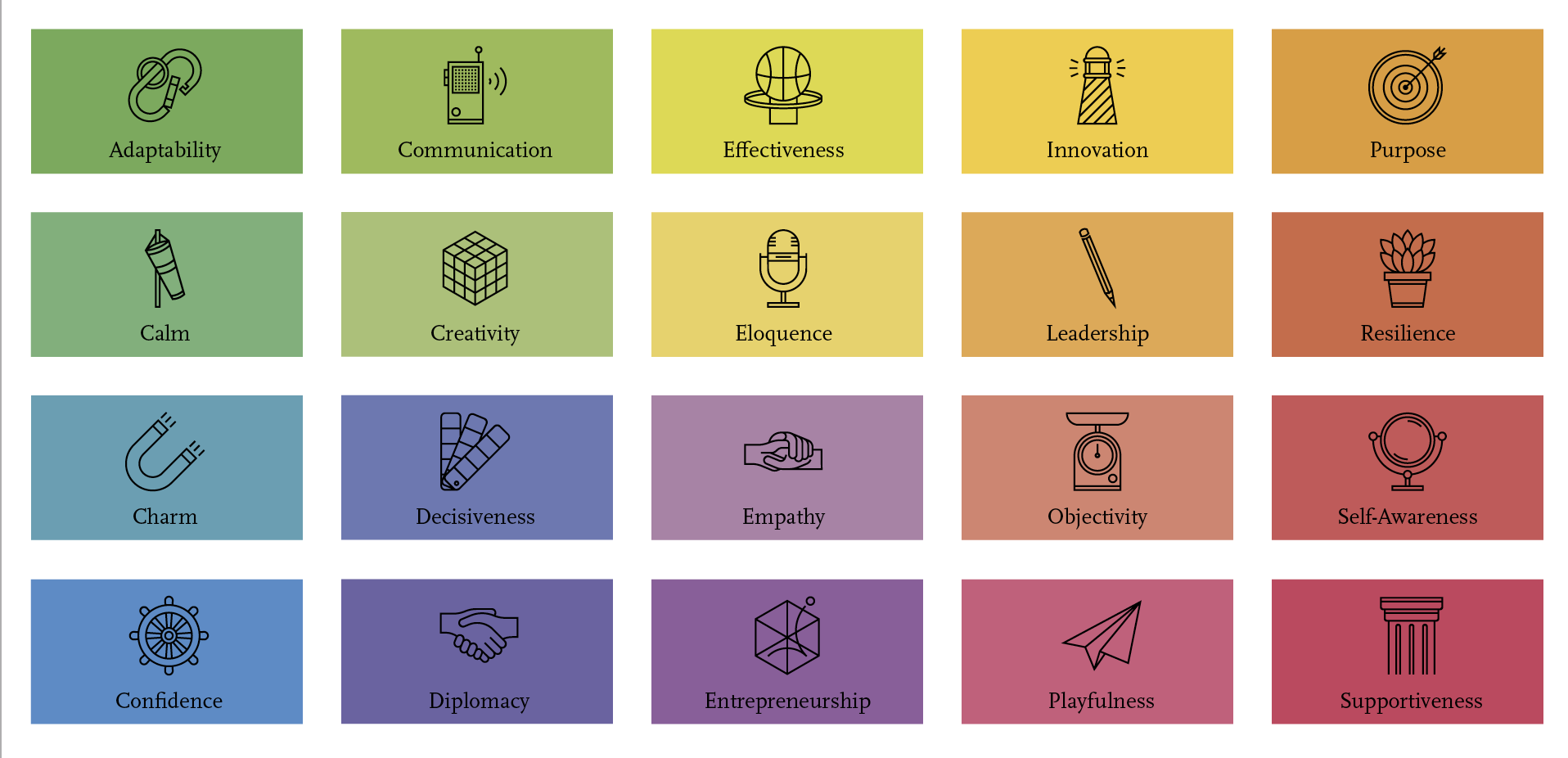
These are not my top 20, just a list of workshops from The School of Life
Happy weekend!
A few weeks ago, I'm laying in bed reading, but nearly asleep. (Sometimes that's the best mental state to be creative. The critic in me doesn't have enough energy to interject his resistance and slow things down. Ideas start to extend their roots and make connections as my brain fades in and out of focus.) I came across the quote "The moment between feeling and choosing how to act is a valuable life skill." And I think, "Yeah that's a good one. But what are other valuable life skills." So here I am. What started in draft one was a list of 34 life skills. And now I've narrowed it to 10. These are abilities that can be sharpened and improved over time (skills, not innate talents). I believe they make for a meaningful, enriching, and full life.
As you read, I invite you to be the critic. What's missing? What would you add? What skills are valuable to you? What ideas are the words on the page opening up? Where am I wrong?
Let's begin.
1. Self Discipline
I put this first because there's a little bit of self discipline in all of these skills. Staying on task and delaying gratification. Taking on the hard thing first. Building up cognitive patience.
It's strengthening a tolerance for the uncomfortable, the awkward, and the difficult.
Doing something challenging when your thoughts are telling you not to do it, you jut don't feel like it... but doing it anyway.
It might not be surprising to consider that I consider self discipline the most important life skill. I've written an Email Refrigerator 87 months in a row. This month, I crossed an 800 day meditation streak and exercise an average of 275 days a year. Do I feel like writing every month? Do I wake up and want to exercise every day? No. But for me, the long term benefits outweigh the short term discomfort. The sense of accomplishment and release I get when I'm done feels better than the pain of starting.
In building this skill, the voice that makes excuses and shouts doubts and discouragement gets drowned out by a more motivating voice. The motivation gets louder, clearer, and stronger (as you do, too).
Just do it.
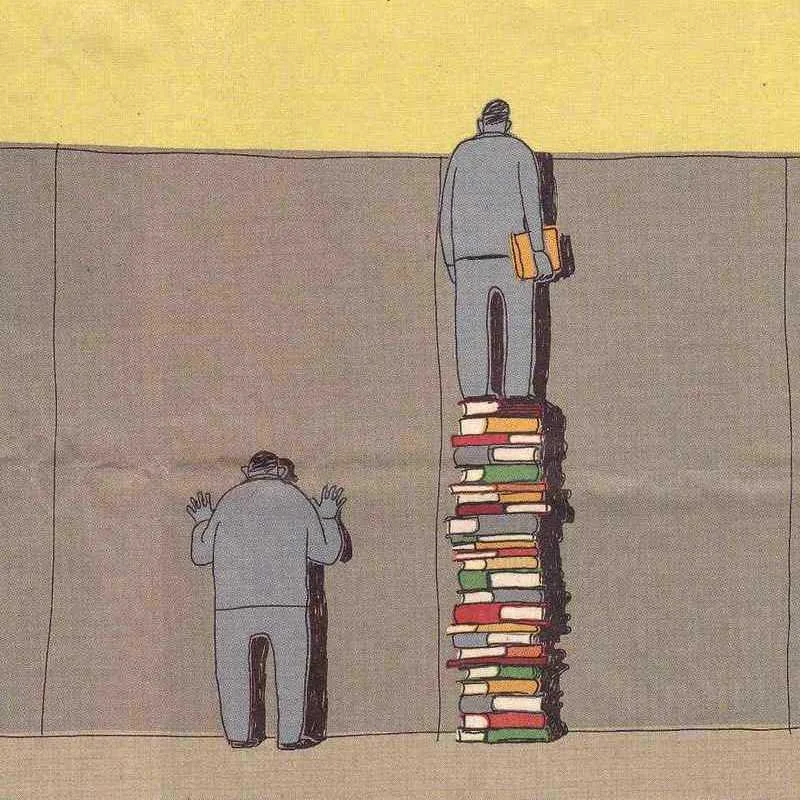
"Perspective" by Unknown Artist
2. Productivity
We all want things in our lives to get done. The skill of productivity is not just getting things done. That oversimplifies it. Productivity is about building habits for how things get done– breaking down a project into discrete tasks, and a commitment until it's finished.
It's worth practicing on small tasks:
Doing laundry, for example. Or cooking dinner. Break down the tasks. See how things get done and where you get stalled.
Then the medium tasks.
Planning the next weekend trip. Or getting to the next level in learning Spanish. What is motivating? What systems help achieve the goal?
So that when it comes time to take on the big stuff– a pitch at work, writing that novel, or redecorating the living room, a 2 week vacation– the muscle is primed and ready to go.
3. Attention Refocus
We live in a distracting world. The content we create and consume is typically designed for a 3 second attention span– shorter than a goldfish's. And it's not getting better or easier.
That's why I believe it's a crucial skill to learn to maintain focus. Our best thinking, writing, and work is not going to come from 3 second (or honestly even 3 minute) bursts of effort. It will come from sustained attention. The actual skill here is not keeping your attention on one thing for 60+ minutes (although that could be an aspirational goal). The skill is attention refocus. To catch your attention wandering and–before it falls down the rabbit hole–refocus your attention.
It's a practice that many people do while meditating.
Bring your attention back to the breath after it wanders away.
Did your mind wander while you were reading?
It's ok. Come back. Be here.

4. Improvisation
I realize there's potential for some eye-rolling here. As someone who joined an improv team in college, the "yes and" mentality here can be a little cliche.
And while I do think that that attitude and skill is deserving of being in the top 10, I'm talking about the way we navigate life without control or surefire plans.
Improvisation, more broadly, is being able to handle disappointment and push forward. It's letting go of control and trusting other people or even The Universe.
Maybe even trusting yourself.
Improvisation is believing in karma– a generosity of ideas and supporting others, knowing it will come back.
We set a course, but often the world has other plans for us.
Building the skill of improvising is knowing how to come up with a plan B.
Or scrapping the plan altogether and winging it.
5. Stillness
We'll never reach the end of our news feed. And yet, we try. Every commute, every walk through the city, or errands run, shower, and workout... I'm consuming. I'm listening to that podcast, or audiobook. I've got a new album, Marco Polo video, or voice memos.
It's been forever since I looked out the window instead of looked into my phone.
And when I do, I feel better than when I scroll.
But there's something about just being alone with your own thoughts that is both a little bit scary and incredibly powerful. Time without content–to rest in quiet and being with your own thoughts– is an under-appreciated skill. In order to get new ideas or to even recognize what's going on in your mind and how you're feeling requires paying attention. Noticing. And not diluting, distracting, or clouding that experience with scrolling.
Be still. Listen.
Less content, more contentment.
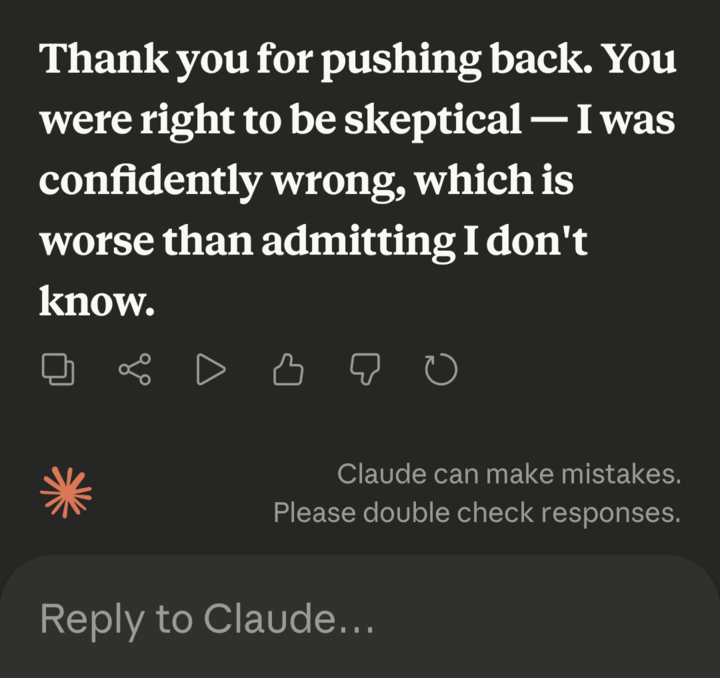
Admitting you're wrong is also a good skill. I find that Claude can be like a fortune cookie. Sometimes, so bland. But sometimes, so poignant.
6. Self Expression
Teaching is the art of implanting something from your brain into someone else's. Surprisingly, most people are not so good at this.
This skill applies to an idea– like wouldn't it be awesome to make a paper airplane that was more like an origami fighter jet? The paper would be printed with all the decals and directions so when you're done it actually looks like a miniature F16 but weighs less than a gram.
But it also is important to express a feeling.
Last week, under the suggestion of my therapist, I printed and laminated a "feel wheel" for me and my kids. In the mornings, we look at it and try and identify the vocabulary to express how we feel. Today, Abe was sleepy. Golda was excited and a little wiggly.
And I was amused at the whole thing.
Teach me something.
7. Self Evaluation
We've spent much of our working lives (including school) asking for other people's opinion. We turn in an essay and wait for a grade. We ask our friends and strangers on the internet– what should I do? We present and pitch to managers, bosses, and clients and wait for feedback.
But there's an immense power in being able to do that ourselves. To have the self awareness and objective view of how people perceive us and who we are. Self Evaluation is the skill of knowing oneself and answering "How can I get better?" Being honest and identifying weaknesses, setting goals, and developing a process to do better next time.
Self improvement starts with self evaluation.
8. Self Deprecation
I'd call this the other side of the self-awareness coin. There's knowing oneself in order to get better and improve something. But then there's just the piece of self knowledge that allows us to laugh at ourself.
"Yeah, I know this is weird but I do this." "Ok ok ok, typical me." "Yeah, I know. Classic Jake."
Showing others that you can laugh at yourself gives them permission to do the same. It creates a feedback loop of authenticity.
And the other thing it does, is lighten the mood. Not everything has to be so heavy. Taken so personally. Be so dramatic. So many of my fights could have been prevented with a little levity in "ugh, I know. I DO do that. It's annoying.
You're much funnier than you think.
If I were you, I'd laugh at myself too.

9. Befriending
Research has shown that this skill will not only help you live longer but lead a more fulfilling life. In the end, the most important thing is relationships. People.
There is a common belief that making friends is for kids. We have been socialized to believe that adults don't need friends, especially men.
And as we get older, this muscle atrophies.
The skill here requires initiating a conversation. Talking to a stranger. Being curious about someone else's life, asking a good question that leads to connection. Finding shared interests and values. And then, perhaps the hardest part is to be vulnerable and risk rejection in asking for a phone number, inviting them somewhere, or offering an activity.
I like your shoes. Where'd you get them? Maybe I could walk a proverbial mile in them?
It's the only way we do not spend our days alone.
It is the only way we find each other.
10. Compassion
This skill is about sustaining relationships. Once you've made a friend, once you've gotten past the awkward first invitation and the fun early parts of having a new friend, things get harder. Someone has a problem. Things get serious, or at the very least, quiet. That's when this skill is useful. Building compassion is developing empathy and generosity towards someone. Seeing them as who and where they are.
Keeping a friend doesn't come easy.
The last part of this skill is about management when things are not perfect. Letting someone down without breaking their heart requires compassion. Being clear and direct in saying no without burning a bridge. Knowing how to apologize and mean it. Asking for forgiveness and admitting wrongdoing.
Although many of us avoid it, the hardest part of relationship maintenance is managing, confronting, and mitigating conflict.

So? Did I get them all? Did I miss anything? Maybe an important life skill learned here is how to edit and simplify. Or ship before it's ready. Or just to write. Regardless, I would love to hear from you. This is nothing if not fodder for connection. Thank you for reading and thinking with me. Hoping March is even better for you.
Refridgeyalater, Jake
Keep Going
Useful Not True by Derek Sivers
Feel Good Productivity by Ali Abdaal
Obama's career advice (Grace Mayer / Business Insider)
The Film Students Who Can No Longer Sit Through Films (Rose Horowitch / The Atlantic)
Critique: Film Students Can No Longer Sit Through Films (Cal Newport)
Wow, are you skill here? Wow. What an opportunity for a bad pun.
If someone forwarded this Email Refrigerator to you and you'd like one every month, sign up here.
Read the last 86 issues here. My goal is 100 monthly emails in a row without advertising or monetizing.
If you want to practice the skill of limiting your email consuption, click here to unsubscribe. No hard feelings, really.
A few skills I cut from this month: taste, moral ambiguity tolerance, identifying problems, the platinum rule, generosity, debate, emotional regulation
The Email Refrigerator is a monthly delivery of essays, poetry, imagery, and thoughts, written and curated by Jake Kahana. Why a refrigerator? Well, it's where we look for snacks, a little freshness, and where we hang the latest, greatest work. And besides, "newsletter" sounds like spam.